To read braille, you work out which of the six dots in each cell are raised and match that pattern to a letter, number or sign. Learn the six dot positions and the first ten letters, a to j, and you can work out most of the alphabet from a simple pattern. This guide takes you through the cell, the alphabet, numbers, capitals and reading by touch, with a chart and a plain-text version for each step.
What Is Braille?
Braille is a tactile writing system. Letters, numbers and punctuation are made from raised dots that a reader feels with the fingertips instead of seeing. It is used by people who are blind or have low vision, and it is written in many languages.
Who invented braille?
Braille is named after Louis Braille, a French inventor who was blind. He developed the system in 19th-century France, building on an earlier raised-dot code called night writing, created by Charles Barbier. Braille’s version used a smaller, simpler cell of six dots, which made it easier to read with a single fingertip.
How Braille Works: The Six-Dot Cell
A braille cell is a grid of two columns and three rows. That gives six positions. Each position can be raised or flat, so one cell can make 63 different patterns using at least one dot, or 64 patterns if you count the blank cell used as a space.
What do the six dots mean?
On their own, the dots mean nothing. A letter is defined by which of the six positions are raised. The dot positions are numbered so that people can talk about patterns easily.
How are the dots numbered?
The numbering goes down the left column first, then down the right column. The left column, top to bottom, is dots 1, 2 and 3. The right column, top to bottom, is dots 4, 5 and 6. So the letter “a” is dot 1 alone, and the letter “b” is dots 1 and 2.
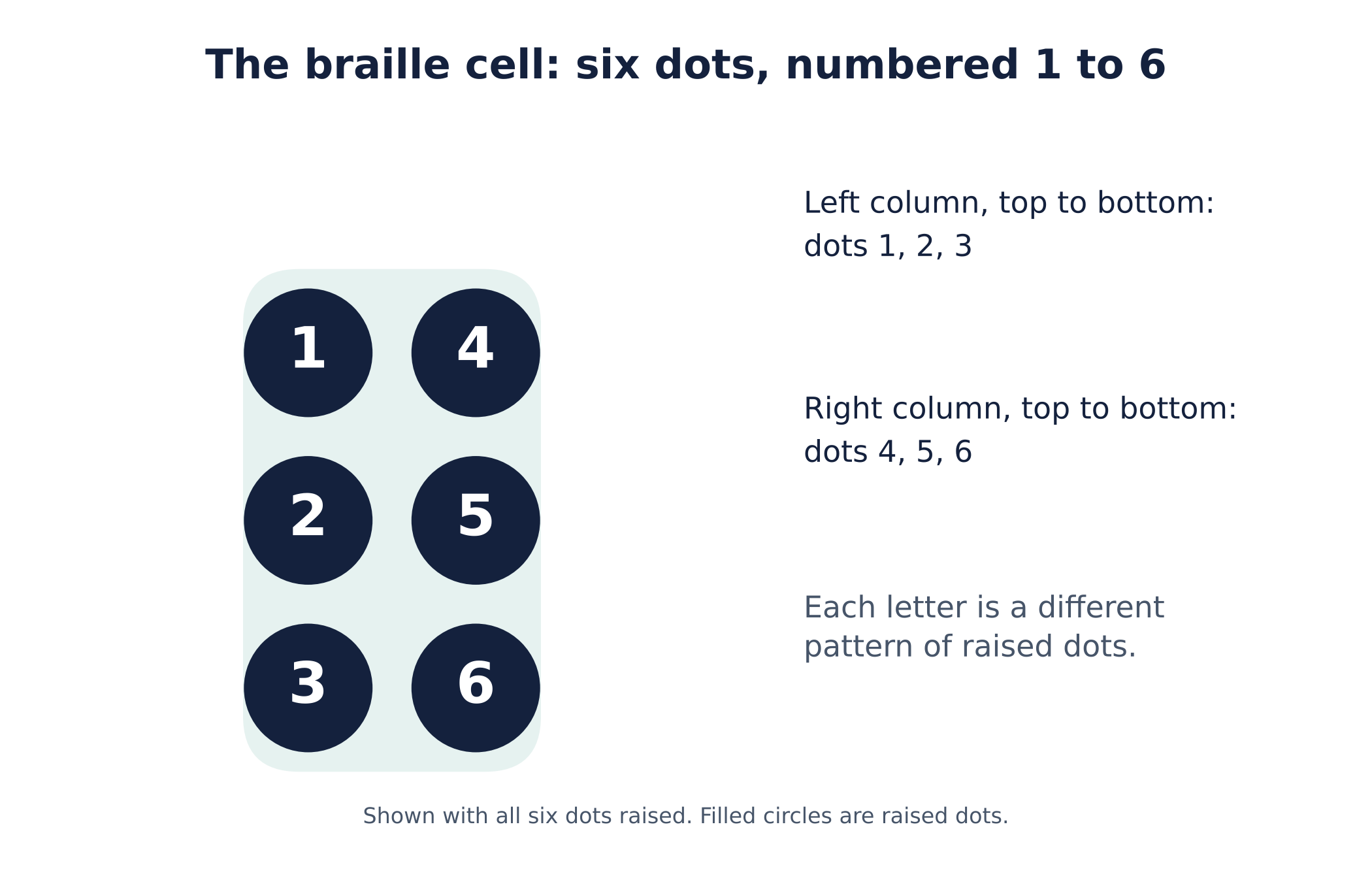
Text version of the diagram:
| Left column | Right column | |
|---|---|---|
| Top row | dot 1 | dot 4 |
| Middle row | dot 2 | dot 5 |
| Bottom row | dot 3 | dot 6 |
How to Read the Braille Alphabet (a to z)
There is no need to memorise 26 separate shapes. The alphabet is built from a small number of patterns that repeat.
Step 1: learn a to j
The first ten letters use only the top two rows of the cell: dots 1, 2, 4 and 5. They are the foundation of everything else.
| Letter | Dots |
|---|---|
| a | 1 |
| b | 1 2 |
| c | 1 4 |
| d | 1 4 5 |
| e | 1 5 |
| f | 1 2 4 |
| g | 1 2 4 5 |
| h | 1 2 5 |
| i | 2 4 |
| j | 2 4 5 |
Step 2: add dot 3 to get k to t
Take each of the first ten letters and add dot 3, the bottom-left dot. That gives the next ten letters. So k is a plus dot 3, l is b plus dot 3, and so on up to t, which is j plus dot 3.
Step 3: add dots 3 and 6 to get u to z (w is the exception)
The last group adds the bottom row, dots 3 and 6, to the patterns for a, b, c, d and e. That gives u, v, x, y and z (for example, a is dot 1 and u is dots 1, 3 and 6). The letter w is the exception: it does not fit the pattern, so it has to be learned separately. Its dots are 2, 4, 5 and 6.
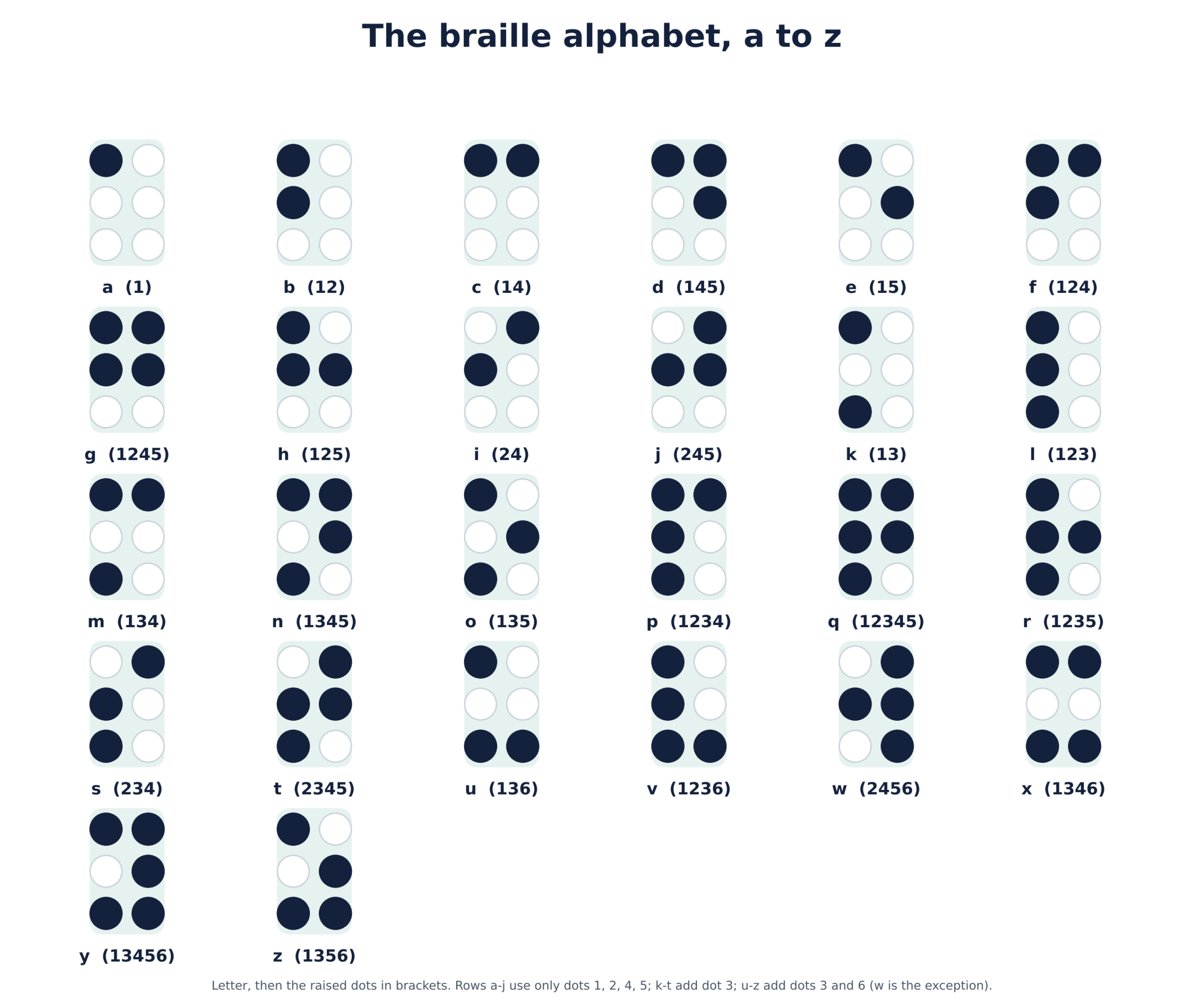
Text version of the full alphabet (dot numbers):
| Letters | Dots |
|---|---|
| a, b, c, d, e | 1; 12; 14; 145; 15 |
| f, g, h, i, j | 124; 1245; 125; 24; 245 |
| k, l, m, n, o | 13; 123; 134; 1345; 135 |
| p, q, r, s, t | 1234; 12345; 1235; 234; 2345 |
| u, v, w, x, y, z | 136; 1236; 2456; 1346; 13456; 1356 |
How to Read Braille Numbers
Braille does not have ten extra shapes for digits. It reuses the first ten letters, a to j, and puts a special sign in front to say “these are numbers, not letters.” That sign is called the number sign, and it is made of dots 3, 4, 5 and 6.
The number sign and the letters a to j
After the number sign, a is 1, b is 2, c is 3, and so on up to i, which is 9. The letter j becomes 0. So the number 12 is the number sign, then a, then b.
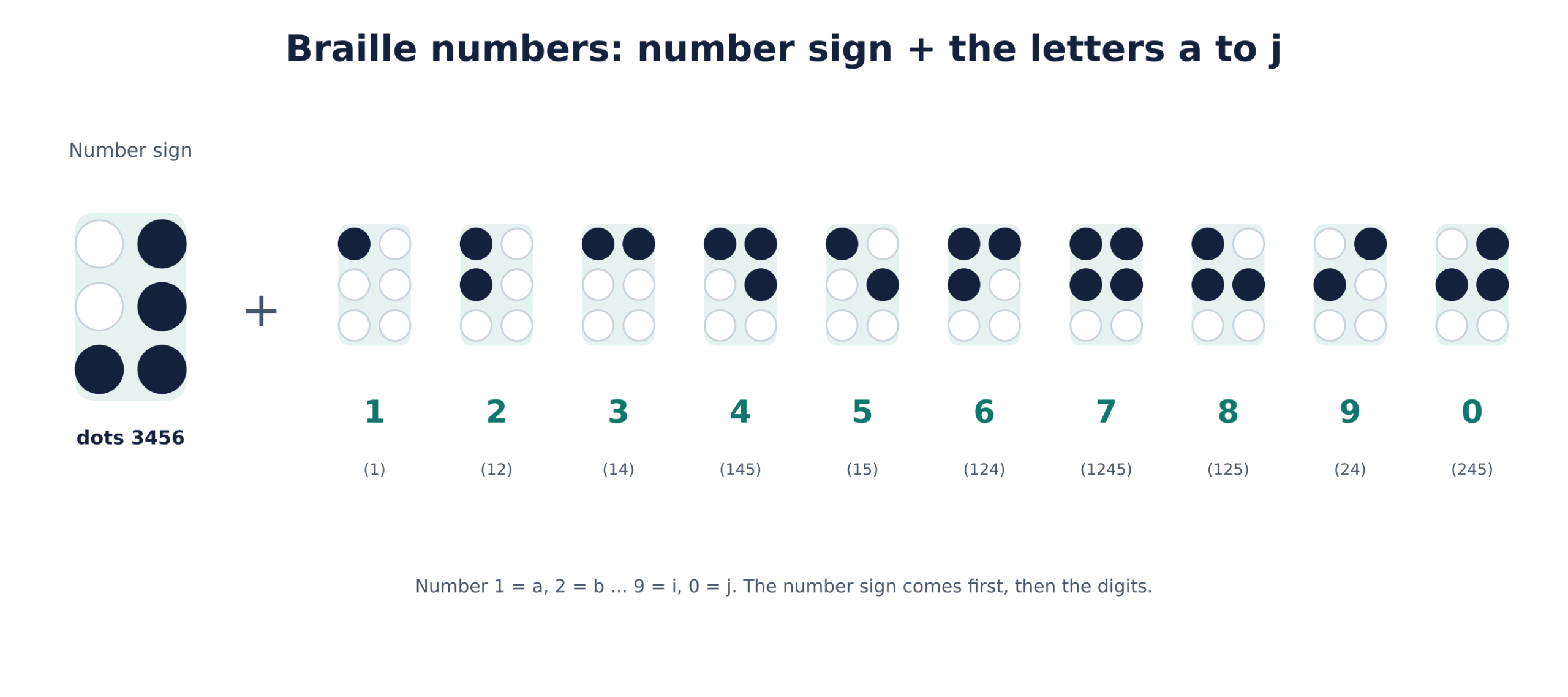
Text version of the numbers chart:
| Digit | Same as letter | Dots |
|---|---|---|
| 1 | a | 1 |
| 2 | b | 1 2 |
| 3 | c | 1 4 |
| 4 | d | 1 4 5 |
| 5 | e | 1 5 |
| 6 | f | 1 2 4 |
| 7 | g | 1 2 4 5 |
| 8 | h | 1 2 5 |
| 9 | i | 2 4 |
| 0 | j | 2 4 5 |
Number sign dots: 3 4 5 6. Read the number sign first, then the digit cells.
How to Show Capital Letters in Braille
Braille letters are the same whether the letter is a capital or not. To show a capital, a sign made of dot 6 alone is placed directly before the letter. When you feel that single raised dot in the bottom-right position, the next letter is a capital.
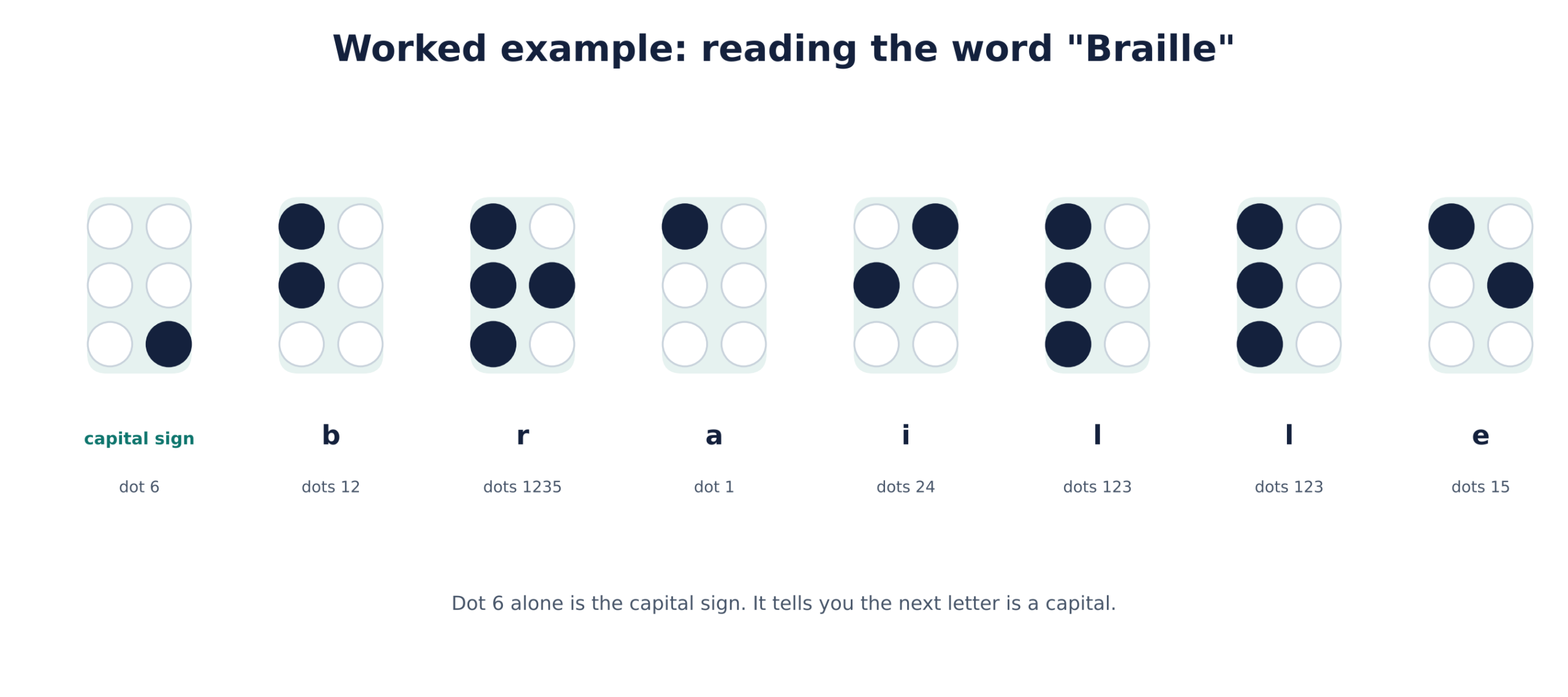
Text version of the worked example: the word “Braille” is written as: capital sign (dot 6), b (1 2), r (1 2 3 5), a (1), i (2 4), l (1 2 3), l (1 2 3), e (1 5).
How Do You Read Braille With Your Fingers?
Braille is read by touch, one line at a time, from left to right, the same direction as print. Readers use the sensitive pad just behind the fingertip, not the very end, and keep the touch light. Pressing harder makes the dots harder to feel, not easier, so the aim is to brush the surface of the dots rather than push into the page.
Most readers use the index fingers, and many also bring in the middle fingers to stay oriented on the line. Fast readers use both hands. In a common method, the left hand reads the start of the line while the right hand meets it near the middle and finishes, and the left hand then moves back to find the start of the next line. Smooth forward movement builds speed, and going back and forth over the same characters slows it down.
Reading by touch feels different from looking at a chart. A sighted learner sees the whole cell at once, while a touch reader senses the dots through the fingertips as the hands move. Learning the dot numbers first, as in the charts above, lets you name what you feel. Looking at a chart is a good way into the code, and reading with the fingers is the skill that makes braille useful in daily life.
Grade 1 and Grade 2 Braille (Contractions)
Once you know the alphabet, you will meet contractions. Grade 1 braille spells every word out letter by letter, as in the charts above. Grade 2 braille uses contractions: single cells or short patterns that stand for common words or letter groups, which makes braille text shorter and quicker to read.
In English, the standard code is Unified English Braille, or UEB. Most braille books and signs use contractions, so beginners usually learn the alphabet and numbers first and add contractions after. You do not need contractions to read this guide, and the dot patterns for individual contractions are best learned from an official UEB chart or a teacher.
How Long Does It Take to Learn Braille?
There is no single answer, because it depends on the learner’s age, whether they used print before, how often they practise and whether they have a teacher. Adults who learned braille after losing their sight describe a similar pattern. Progress is slow at first: one learner reached about 12 to 16 words per minute after three months of daily classes, and in the first days could feel that dots were there without telling which ones. Others report reading their first book within months and reaching 60 to 100 words per minute after six to nine months of regular practice with both hands. Readers and instructors agree that it is never too late to start, and that regular reading practice is what builds speed.
Can You Read Braille With Your Eyes?
Yes. Sighted people can read braille by looking at the dots, as in the charts in this guide, and many teachers, parents and braille transcribers learn it that way. Braille is designed to be read by touch, though, and raised dots are much easier to make out with the fingertips than printed dots are to see on a page.
How to Practise and Where to Learn More
- Learn the six dot positions in the cell.
- Learn a to j, then k to t, then u to z.
- Learn the number sign and the digits.
- Add the capital sign.
- Read short words, then short sentences, from a chart or practice sheet.
- Move on to contractions with a UEB guide or a teacher.
Good places to continue are the Perkins School for the Blind, the Braille Authority of North America (BANA), the American Foundation for the Blind (AFB) and the Library of Congress National Library Service (NLS). If you want to read with technology, see our guide to reading apps for blind and visually impaired people, our guide to assistive tools and devices for blind people and our explainer on how blind people use computers, including braille.
Frequently Asked Questions
How do you read braille?
Reading braille means matching the raised dots in each cell to a letter, number or sign. Each cell has six positions, and the pattern of raised ones identifies the character. Start with the letters a to j, because the rest of the alphabet builds on them.
How do blind people read braille?
Blind readers read braille by touch. They move their fingertips along each line from left to right and recognise each cell as it passes under the fingers. Fluency comes from regular reading practice.
What do the six dots in braille mean?
Individual dots have no meaning on their own. A character is defined by which of the six positions in the cell are raised. The dots are numbered 1 to 3 down the left column and 4 to 6 down the right so that patterns are easy to describe.
How do you read braille numbers?
A braille number is written with the number sign, which is dots 3, 4, 5 and 6, followed by the letters a to j. The letters a to i stand for 1 to 9 and j stands for 0. So the number sign followed by a and b reads as 12.
How do you show a capital letter in braille?
A capital letter is shown by dot 6 alone, placed directly before the letter. The capital sign is the cell with only the bottom-right dot raised.
What is the difference between Grade 1 and Grade 2 braille?
Grade 1 spells each word out letter by letter. Grade 2 uses contractions that stand for common words or letter groups, which makes text shorter.
Can you read braille with your eyes?
Sighted people can read braille by looking at the dots, and many teachers and parents learn it this way. Braille is designed to be read by touch.
Who invented braille?
Louis Braille, a blind Frenchman, developed it in 19th-century France, building on Charles Barbier’s earlier raised-dot night writing.
Start with the chart
Braille looks complicated until you see that it is a small set of repeating patterns. Learn the six positions, learn a to j, and you already hold the key to most of the alphabet and to the numbers as well. Start with the chart above and spend ten minutes with it today.