How does a blind person cross the road? They find the kerb with a long white cane or a guide dog, line up straight with the crossing, listen to traffic to judge when it is safe, and then walk across in a straight line, using sound cues and, where they exist, accessible signals. The person decides when to cross, not the cane or the dog.
This guide is written for people without a visual impairment who wonder how it works. It is also useful for blind and low-vision pedestrians, their families and anyone who wants to help safely. It describes the general method taught in orientation and mobility training. Techniques vary by person, place and country, so treat it as an overview and not as safety instruction. Let’s get started.
How does a blind person cross the road step by step?
- Find the crossing. The person uses a long white cane to find the kerb edge, any kerb ramp and, where it exists, tactile paving. Many people choose a signalled crossing when one is available.
- Stop at the edge and line up. They stand square to the direction they want to cross, so the first steps go straight. Drifting is a common problem, which is why lining up carefully matters.
- Listen and learn the pattern. At a signalled crossing they listen through at least one full cycle to learn when traffic runs and stops, and whether cars turn across the crossing.
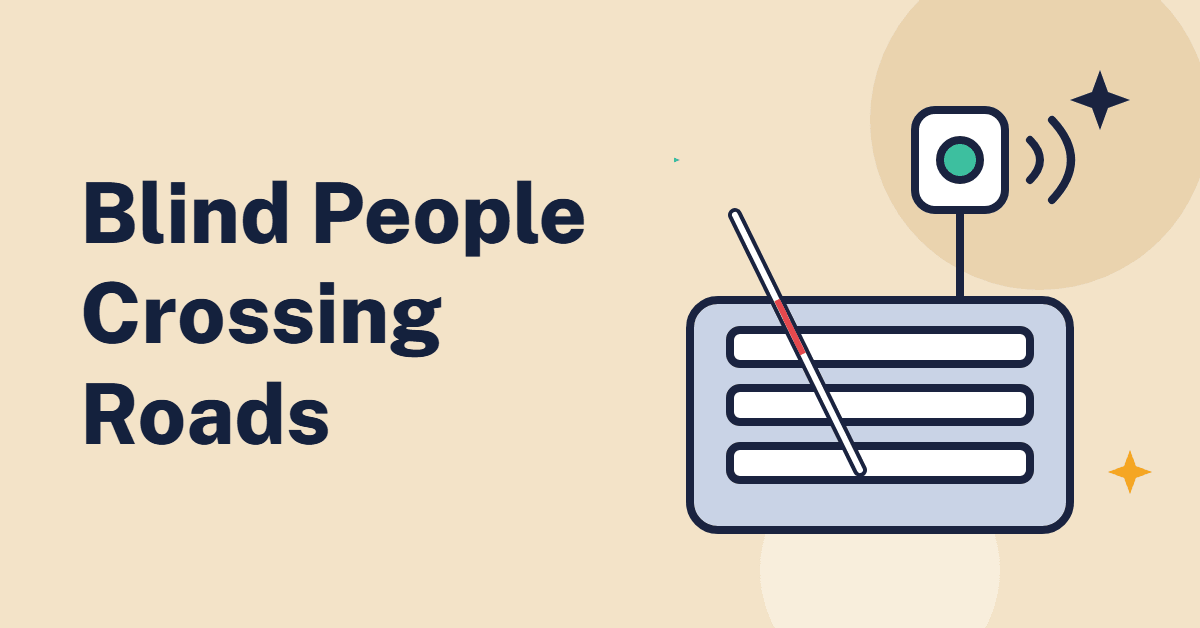
- Check for accessible signals. Beeps, chirps, a vibrating button or, in the UK, a small rotating cone under the control box show when it is time to cross. They keep listening anyway, because signals can fail and many crossings have none.
- Decide when it is safe. At signals, the traffic running alongside their path starting up is the cue that their turn has begun. At crossings without signals, they wait for a gap with no approaching vehicles. If they are unsure, they wait for the next cycle.
- Cross in a straight line. The cane stays out in front, or the guide dog leads. The sound of parallel traffic helps them stay on line, and some people also notice the road sloping up toward the centre. Turning cars can mask those sounds.
- Reach the far kerb. They find the opposite kerb with the cane or the dog, step up and move away from the traffic. If they have drifted, they correct and carry on.
What does a white cane do when crossing?
The long white cane finds the kerb edge, ramps, tactile paving and obstacles in the path. It also shows other road users that the person may not see them. For more on the cane and other mobility tools, see this guide to primary traveling aids for a blind person.
How does a guide dog help a blind person cross the road?
A guide dog leads in a straight line, stops at kerbs and steers around obstacles. It cannot tell when a light has changed, because dogs do not see colour well. The handler listens to the traffic, decides when to cross and gives the forward command. The dog is trained not to walk into oncoming traffic, even when told to go.
What makes crossing harder for blind pedestrians?
Quiet electric and hybrid vehicles are hard to hear. In the United States, a federal law now requires them to make a warning sound, but the rules differ elsewhere. Cars turning through a crossing can hide the sounds that show which way is straight. Crossings with no signals, wide junctions, roundabouts and slip lanes give fewer cues, and vehicles parked across a crossing or on tactile paving block the route.
How do blind people learn to cross roads?
They learn through orientation and mobility training. A specialist works with the person on lining up, listening for traffic, using the cane or guide dog and picking up local cues, and may point out cues the person had missed. Everyone ends up with a slightly different method. Many people also use apps to plan the route to a crossing, which is covered in this list of navigation and travel apps for the blind.
How can you help a blind person cross the road?
Ask first, and wait for the answer. If they say yes, offer your elbow and let them take it, and describe anything unusual, such as roadworks. Do not grab, pull or steer them, and do not take or touch the cane or the dog. Do not shout “go now” or call out directions. As a driver, stop fully and wait, do not honk or wave, and do not park on a crossing or on tactile paving.
Frequently asked questions
Can a blind person cross the road alone?
Many blind people cross roads alone every day after orientation and mobility training. They choose signalled crossings where possible and sometimes ask for help at complex junctions.
How does a blind person know when the traffic light is green?
A blind person cannot see the light, so they use sound. They listen for the surge of traffic moving in their direction, or for an accessible signal where one exists.
Do guide dogs know when to cross the road?
A guide dog cannot tell when a light has changed, so the handler decides when it is safe. The dog guides the way and will refuse to go if a vehicle is coming.
How do blind people cross the road without traffic lights?
At a crossing without signals, a blind pedestrian listens for approaching vehicles and crosses when none is heard. On a busy road or a complex junction, they may look for a signalled crossing or ask for help.
What should I do if I see a blind person waiting to cross?
The best approach is to ask whether they want help and wait for their answer. If they accept, offer your elbow and follow their lead. If they decline, step back and do not insist.
Are quiet electric cars dangerous for blind people?
Quiet vehicles are harder to hear, which removes the main cue blind pedestrians rely on. Some countries require warning sounds on them, but the rules differ by country.
Sources and last updated
Last updated: 19 October 2026. Rules and equipment differ by country, so check local guidance before relying on a detail.
- Walking Info: how pedestrians who are blind cross at signals
- Guiding Eyes: how guide dogs and handlers cross the street
- Chicago Lighthouse: how people who are blind know when it is safe to cross
- Henshaws: how to cross the road safely when you are blind
- Perkins: how does a blind person cross the street
Related reading