
What Are Kitchen Adaptations for the Blind and Low Vision?
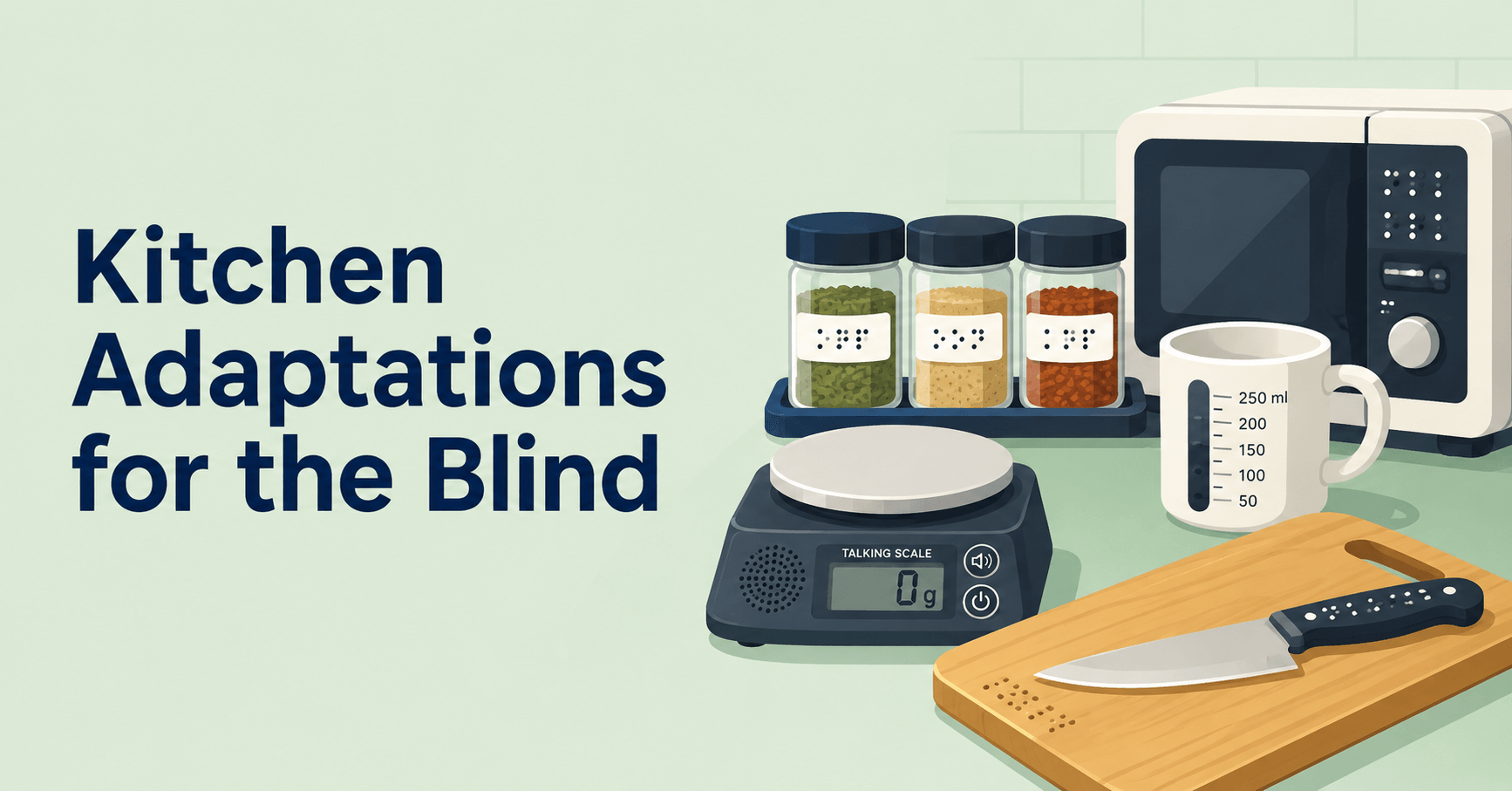
Kitchen adaptations for the blind and low vision come down to three systems. A fixed organizing method gives every item one home. Tactile and audio labeling means identification does not depend on sight. Touch-based safety techniques handle heat, blades, and liquids. Get these three right and independent cooking stops being a risk and becomes routine. This guide covers the cooking process itself, scoped to the kitchen. For appliance shopping, layout, lighting, and contrast changes elsewhere in the home, see the home modifications guide linked below.
Kitchen safety checklist:
- Keep every item in a permanent location.
- Label pantry items that could be confused with each other.
- Turn pot handles inward.
- Use the claw grip while cutting.
- Pour with a liquid level indicator or the finger hook technique.
- Mark appliance controls with bump dots.
- Keep a talking timer nearby.
Kitchen Adaptations Begin With Organizing, Not Tools
Organization is the foundation. Without it, every other adaptation fails, because a labeled item you cannot find is not actually accessible. See the broader guide to home modifications for the blind and visually impaired for changes outside the kitchen.
Zone the kitchen by task, not by category. Keep everything used for cutting in one drawer, everything used for measuring in one spot, everything used for seasoning in one rack. This reduces search time and memory load.
Assign a permanent home to every item and enforce it as a household rule: family members and guests return things to their exact spot, always. One moved item can undo weeks of built-up spatial memory.
Use bins and dividers inside cabinets and drawers so items cannot slide out of place. A shallow drawer organizer for utensils works better than a deep open drawer where things shift.
Task lighting matters as much as organizing for readers with usable vision. Bright, focused lighting over counters and under cabinets, positioned to avoid glare, makes each zone easier to use. A warm, high-lumen bulb also reads more clearly than a dim or blue-toned one for most people with low vision.
Habits That Keep the System Working
The organizing rule above only holds if daily habits reinforce it; the habits themselves are worth setting up deliberately.
Use a shallow tray as your actual prep surface, not just the counter. Set out everything you need before starting. Put unused items on the left and a scraps bowl in one corner for peels and packaging, then move each item to the right side as you finish with it. At the end, everything needing cleanup or storage is already sorted into one place, and any spill stays contained on the tray instead of spreading across the counter.
Keep a wet towel at your prep area to wipe your fingers as you go. This cuts down on trips to the sink and stops sticky or wet fingers from spreading mess to everything else you touch.
Treat resetting the kitchen as the last step of every recipe. Tools go back to their assigned spot and counters get cleared before you consider cooking finished. This daily habit is what keeps the organizing rule from drifting out of place over weeks.
Keep a small basket on the counter during cooking for soiled or wet cloths, towels, and gloves. This avoids repeated trips to the laundry room mid-task and keeps mess from building up on the counter itself.
Labeling Systems That Work Without Sight
Labeling only works if it survives daily kitchen use, meaning heat, moisture, and handling. Label only what is actually confusable. A can with distinctive packaging, like a tall shortening tin, needs no label; two similarly shaped cans, like tuna and cat food, or a row of cereal boxes, do. This saves time versus labeling every item on principle.
Braille labels stuck directly on cans, jars, and containers are durable and do not wear off like ink. A braille label maker or pre-printed braille label sheets both work well for pantry staples. Large-print, bold labels in a color that contrasts with the container serve the same purpose for readers with usable vision. They work with the same fixed-location system rather than a different one.
Apps built specifically for this, such as WayAround or Hable’s SpeechLabel, let you record a short voice note and attach it to an NFC tag or QR sticker. A tap of the phone plays it back in under a second. These are most useful for items that change contents often, like leftover containers or a meal prep box you refill each week. A fixed braille or rubber-band label cannot keep up with that.
Rubber bands and notches are a low-cost, no-tech option. Wrap one rubber band around salt, two around sugar, a notch cut into a lid for flour. This works when you do not want to depend on an app or a physical label running out.
Bump dots placed on oven and microwave control panels mark the exact settings you use most, so you do not need to count buttons every time. For appliances with flat touch panels where a single dot is not enough, HALOS tactile overlay kits replace the entire control layout with raised, feelable icons designed for that purpose.
| Method | Best for |
|---|---|
| Braille labels | Pantry staples |
| Large-print, high-contrast labels | Pantry staples, low vision |
| Audio labels | Leftovers and items that change contents |
| Rubber bands and notches | Frequently used spices |
| Bump dots | Appliance controls |
| Talking scale | Measuring ingredients |
| Liquid level indicator | Pouring liquids |
Smell Is Useful, Not Infallible
Smell is often treated as a reliable backup for sight, but it has real limits, and spices are where this shows up most. Cumin and coriander, or two similar chili powders, can smell close enough to confuse even an experienced cook. A blocked nose or a stronger smell already in the air from cooking makes this worse.
This is exactly where it is tempting to over rely on technology as the fix, and where that trust is misplaced. An audio tag or labeling app only works if it was set up correctly and nothing has shifted since it was recorded. It does not replace the habit of checking before adding, every time, rather than assuming a system from last week still holds.
Consistent process and awareness are what prevent the mix-up. The households that stay accident free have a fixed habit of double checking a spice by touch, weight, or a second smell test before adding it. That habit matters more than any stack of gadgets.
Heat and Burn Safety
Heat safety relies on consistent hand positioning, more than on extra caution alone.
I have burned my hand more than once. Usually it is not while cooking directly but from grabbing a hot pan or utensil left on the counter while my attention was on another burner. It is not unique to being blind; sighted cooks do the same thing, and I do not treat it as a special hardship. What actually prevents it is a consistent habit of checking before I reach, every time, not just after a burn reminds me to.
Use the back of your hand or knuckles, not your fingertips, to feel for heat near a stove or oven before placing your hand fully on a surface. This gives you a warning without full contact.
Wear short sleeves, or roll long sleeves above the elbow, before working near an open flame or hot surface. Loose fabric catching on a burner is a real and avoidable risk, separate from anything the hands are doing.
Turn pot handles inward or to the side rather than out over the edge of the stove. This one habit prevents most accidental knocks and spills before they happen.
If you are choosing a stove rather than adapting an existing one, an induction cooktop is worth considering for this reason specifically. The cooktop surface itself stays far cooler than gas or standard electric, since the pan generates the heat rather than the surface underneath it. The pan itself still gets hot, so this reduces one specific risk, accidental contact with the cooking surface, without removing the need for the other techniques here.
An audible smoke detector is a baseline safety net that belongs in every kitchen alongside these techniques. Confirm yours has a sound alert loud enough to hear over a running exhaust fan.
Pouring and Liquid Safety
Pouring safety comes down to tracking the level as it rises, using touch or a device instead of sight.
Add pasta, rice, or vegetables to the water before it starts boiling rather than after. This avoids the splash hazard of dropping ingredients into water that is already at a rolling boil.
Pour liquids using a finger hook over the rim of the cup or pot to sense the liquid level rising. Or use a liquid level indicator that clips to the rim and beeps or vibrates near full.
Cutting and Prep Technique
Cutting safety comes down to blade awareness before the cut, not just grip during it.
Before cutting, identify the blade edge by resting the knife flat on the counter and rocking it gently; the side that rocks is the cutting edge. This confirms blade orientation without touching it.
For cutting, a claw grip with fingertips tucked back and knuckles guiding the blade keeps fingers away from the edge. Pair this with a cutting board that has a raised-edge or non-slip backing so the board itself does not shift. Round vegetables such as onions or potatoes are easier and safer to cut after slicing a thin piece off one side first, to create a flat base that will not roll. A light-colored board for dark food, and a dark board for light food, adds a visual layer for readers with usable vision. This layers on top of the claw grip and blade-edge check. A pizza cutter, rocker knife, or finger guard is worth trying as an additional option alongside the claw grip for some tasks.
Grate or chop directly into a bowl rather than onto a flat surface. The bowl contains the food automatically, so nothing needs to be located and gathered afterward.
Keep a separate cutting board for raw meat and one for ready to eat foods, and make the two easy to tell apart by touch, not just by memory. A raised tactile sticker on one, or two boards with clearly different textures or edge shapes, prevents cross contamination without needing to see which is which.
Use a second spatula or a pair of tongs to stabilize food while flipping it, rather than relying on one hand and a single utensil. This keeps the pan steady and reduces the chance of food sliding off.
Tools Worth Buying First
Start with the tools that solve the most frequent risk before adding more for their own sake.
Four tools cover the four highest risk tasks. A liquid level indicator handles pouring, a talking kitchen scale handles measuring, bump dots handle appliance control, and a claw grip cutting board handles cutting.
A cut-resistant glove and an oven mitt that covers the forearm add a second layer of protection specifically against cuts and burns.
A talking meat thermometer removes the guesswork on thicker cuts. Tactile measuring cups and spoons with raised markings are a simple backup for whenever weighing is not necessary. A talking or tactile kitchen timer removes the guesswork of judging cooking time by smell or sound alone.
Large-print or bold-marked measuring cups and spoons, and a handheld magnifier or OCR app for reading small packaging text, serve the same role for readers with usable vision.
Everything else can be added once these are in place.
Where Screen Readers and AI Tools Take Over From Kitchen Tools
Once the physical kitchen is set up, the remaining challenge is information. Recipes, use-by dates, and unlabeled packaging are not solved by bump dots or organizing systems. That is where screen readers, AI, and camera-based apps become useful, working alongside the physical adaptations rather than replacing them.
Two separate options exist here rather than one combined workflow. A phone on a countertop stand, running a recipe aloud through VoiceOver, is low-touch rather than fully hands-free. It reads continuously once started, but still needs an occasional swipe to move forward, and does not remove touching the phone entirely.
For a fully hands-free option, use Alexa voice commands directly. Ask Alexa to find a recipe, or use a recipe skill, then control it entirely by voice with commands like repeat, next step, and how much of an ingredient. This only works when Alexa itself is reading the recipe, not when it is paired with a separate phone app.
Seeing AI or Be My Eyes cover the gaps physical labels cannot. A can with no braille label, a printed use-by date, or a delivery bag with unmarked items are all solvable by holding the item to the camera rather than guessing.
A talking kitchen scale removes the need to check a screen for weight while your hands are busy adding ingredients. Dedicated talking scales have voice output built in and need no app at all. A Bluetooth smart scale is the weaker choice here, since the companion apps for those are often not fully accessible with a screen reader beyond the basic weight readout.
What Still Goes Wrong, Even With All of This in Place
No system is complete, and pretending otherwise sets up unrealistic expectations. A few failure points are worth naming honestly.
Labels get moved or removed by someone else in the household despite the rule. Restating it in the moment it slips works better than a better label; enforcement, not the label itself, is what holds.
Apps and audio tags fail at the worst moment, mid-recipe, low battery, or no signal. Keep the rubber band and notch system running as a backup even after you adopt tech tools, since it needs no charge and no connection.
Placing the first set of audio tags accurately is the one step in setting up an audio labeling system that often needs sighted help; scanning them afterward is fully independent. Budget for that one session rather than expecting to do it entirely alone.
Confidence drops after a burn or a spill, more than the injury itself. That is normal. The recovery is the same for every cook, sighted or not: go back to the exact technique that failed and slow it down once. Rebuilding trust in the method works better than avoiding the task.
Frequently Asked Questions
How do blind people know when a pot is boiling?
Blind cooks listen for the change in sound as bubbles form and rise, and feel steam rising above the pot with the back of the hand held at a safe distance. Some also use a timer set to the expected boil time as a backup rather than relying on sound alone.
What is the safest way for a blind person to cut vegetables?
The claw grip is the standard technique: fingertips curl back and knuckles rest against the flat side of the blade to guide it, so the blade never meets exposed fingertips. A cutting board with a raised-edge or non-slip base prevents the board from moving during the cut.
Can blind people use a regular stove safely?
Yes. Bump dots marking the exact dial positions used most often, combined with a back of hand heat check before touching any surface, make a standard stove safe to operate independently. This works on gas and electric stoves alike, with no special equipment needed beyond the bump dots themselves.
How do you label spices without sight?
Braille labels stuck to the jar lid are the most durable option, since they do not smudge or wear off from handling. A rubber band system, one band for common spices used daily and none for rarely used ones, also works as a free backup method.
Do you need expensive equipment to cook independently as a blind person?
No, the highest impact tools, bump dots, rubber bands, a liquid level indicator, and a raised-edge cutting board, all cost very little. A talking kitchen scale is the one item to spend more on, since it is the most accurate way to measure both liquids and dry ingredients.
How can a blind person tell when meat is fully cooked?
Smell and texture are the primary signals, since cooked meat firms up and its smell changes distinctly from raw. Some cooks also notice a shift in the sizzling sound as moisture cooks off, though a talking meat thermometer is the more reliable way to remove guesswork on thicker cuts.
How do blind people measure ingredients accurately?
A talking kitchen scale reads out weight aloud, which is the most accurate method for both liquids and dry ingredients. Tactile measuring cups and spoons with raised markings, or pinch bowls used to pre portion ingredients before cooking starts, are common lower-cost alternatives.
How do blind people know if food has gone bad?
Smell catches most spoilage, but not all of it; listeria, for example, does not reliably change smell even when food is unsafe. Proper refrigeration and labeling leftovers with the date made are the real safeguards, with smell as a secondary check only.
Can a blind person safely use a microwave?
Yes, bump dots placed on the most used buttons, typically one minute, thirty seconds, and start, remove the need to read a screen. Newer microwaves with a simple tactile dial are often easier to adapt than touchscreen models, which is worth checking before buying one.
How do blind people follow a recipe while cooking?
A phone or tablet on a stand, read aloud through VoiceOver or TalkBack, works but still needs an occasional swipe to move forward. For a fully hands-free option, ask Alexa or a similar voice assistant to read the recipe directly and say repeat or next step.
What’s different about kitchen safety for low vision versus total blindness?
Low vision adds a visual layer on top of the touch-based techniques in this guide, rather than replacing them: high-contrast cutting boards, bright task lighting, and large-print labels. Both groups rely on the same organizing, labeling, and safety habits described throughout.
